
Watertown Neighbors: Block Records
Public sources describe a Watertown block from several angles. MapGeo supplies geometry, Vision supplies assessment evidence, and deeds answer title questions that a map cannot settle. A local voter-list request can address a defined public-record question, but the statewide self-status tool is not a block search. Historical directories are useful only when the question concerns earlier occupants. Read the table as a source map, not as a promise that every neighboring household appears in public records.
| Source | What It Shows About a Block | Access |
|---|---|---|
| Watertown MapGeo | Parcel boundaries, roads, buildings, zoning, aerial, and infrastructure context | Free public viewer |
| Vision and FY2026 parcel inventory | Assessed owner, mailing address, situs, and assessment details by parcel | Free search and spreadsheet |
| Middlesex South deeds and plans | Title-based adjacency, easements, subdivisions, and legal descriptions | Free online view; certified-copy option |
| Watertown local voter list | Releasable registered-voter fields for specified addresses or precincts | City Clerk written request; protected fields withheld |
| Library directories | Historical occupant or business context for selected years | Watertown Library collections |
Property evidence identifies an assessed owner, not every current occupant. A tax mailing address can point outside Watertown, and an owner may not live at the parcel. Likewise, a missing name on a local voter list is not proof that a person is absent, because protected and non-public records are excluded.
Start with the smallest useful area. One address and the adjoining parcels produce a more reliable question than a broad neighborhood label. Record the source, search date, and whether a name came from an owner, a recorded party, a public voter field, or a historic directory. That simple separation prevents a block map from becoming a claim about a household.
Map Watertown Neighbors by Parcel
Watertown MapsOnline on MapGeo is the practical first stop for the immediate block. Search the exact address, click its parcel, preserve the parcel or map-lot identifier, then zoom out to the polygons touching or bordering the site. The City describes MapGeo layers for tax parcels, roads, buildings, zoning, aerial photography, water and sewer. Those layers distinguish a lot line from a building outline or public right-of-way.
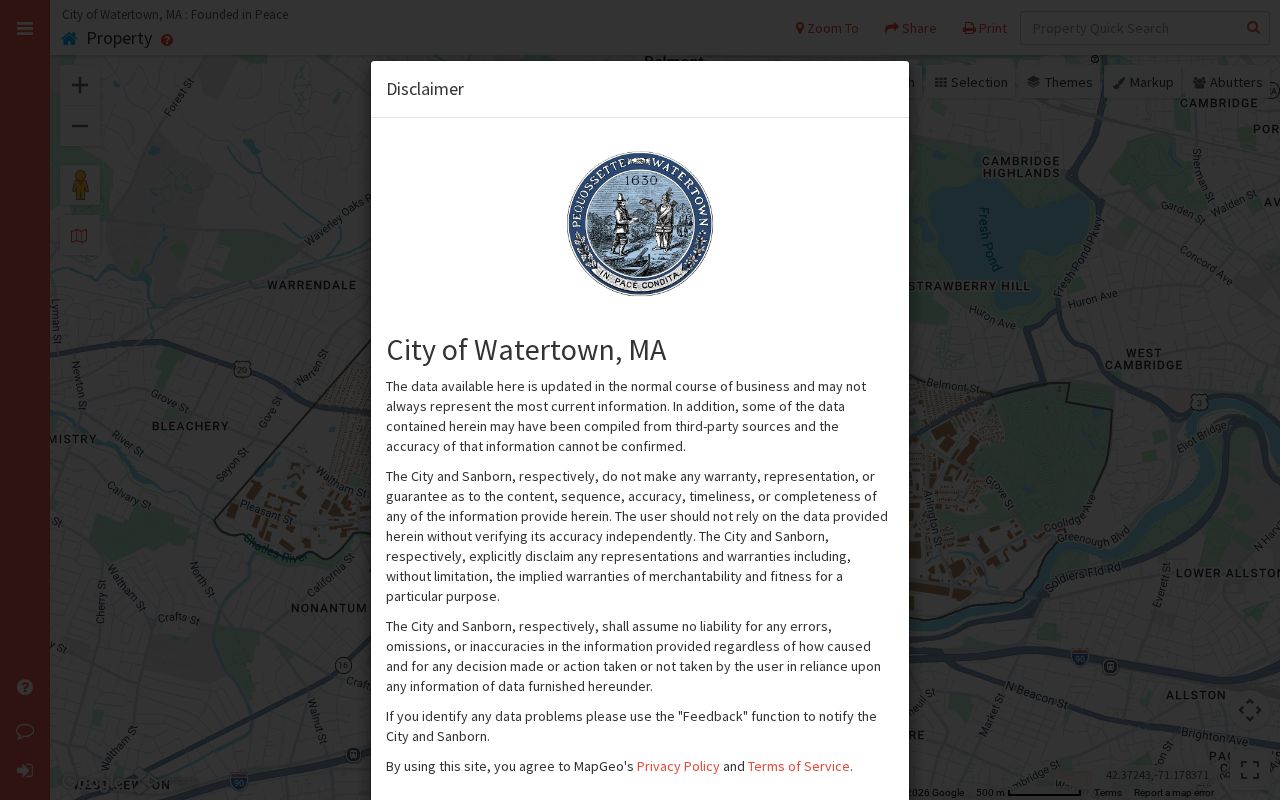
The parcel view provides the geometry for a neighbor search, but the City says it is a reference map rather than a legal survey.
MapGeo also links the block to civic geography. Precinct, road, zoning, and infrastructure layers can explain why an apparent neighbor is separated by a public facility, a right-of-way, or another mapped feature. Print or download functions can preserve a working reference, but the parcel map should never replace the controlling deed or plan.
- Address: locate the known Watertown address in MapGeo and save the parcel identifier and street.
- Parcel: inspect the selected polygon and switch on roads, buildings, zoning, or aerial layers when they clarify the edge.
- Adjacent parcels: pan or zoom to each adjoining polygon, while noting public ways, river edges, easements, and condominium geometry.
- Owners: search each confirmed address or parcel in Vision for the assessed owner and mailing-versus-situs fields.
- Title check: use a deed, plan, or legal description where a shared boundary matters. For a full named-street record trail, use the Watertown streets lookup.
Watertown Neighbors in Vision Records
Watertown's Vision property database supports owner-name, property or address, and parcel-identifier searches. A result can show the assessed owner, tax-bill mailing address, situs or property address, parcel identifier, assessment fields, land-use code, sale or deed reference, and exemption information where published. The City also provides a FY2026 inventory that reflects ownership and assessment information as of December 2025.
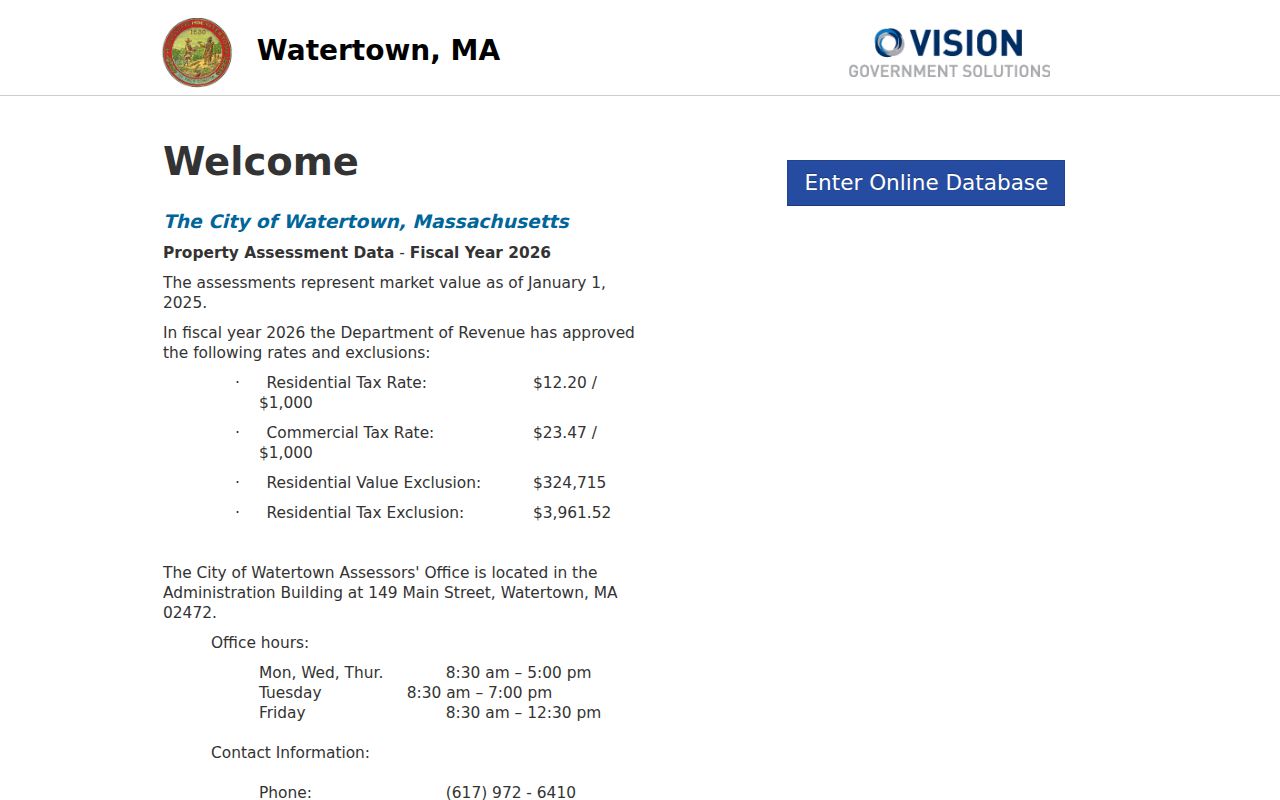
Use the assessment result to identify the parcel's assessed owner, then label it accurately instead of presenting it as proof of every person at the address.
A residential exemption can be an owner-occupancy signal, but it is not conclusive. The research records a FY2026 exclusion of $324,715 and savings of $3,961.52, yet neither amount nor flag establishes household composition. A mailing address may belong to a trust, manager, bank, or owner contact.
When the card contains a sale or deed reference, use it as a pointer to MassLandRecords rather than a substitute for the recorded instrument. Search the parcel identifier when a street address is ambiguous, and keep any change in ownership separate from a conclusion about who occupies the block now.
Watertown Block Boundaries Need Deeds
Visual proximity is not the same as legal adjacency. A river-edge lot, easement, public way, or condominium can make two nearby polygons unrelated in title. Search Middlesex South Recorded Land by party, property, town, plan, date, book, or legal description when the map does not resolve a boundary. The registry's plan and registered-land modes are useful when book and page alone are not enough.
- Situs address
- The physical location of a parcel used by the assessment record.
- Parcel boundary
- The mapped edge of a tax parcel, which remains a reference until confirmed by the controlling land record.
- Legal description
- The title description of a lot, plan, boundaries, or related land reference.
- Easement
- A recorded right affecting land use or access that can explain why a map edge does not describe a social boundary.
Watertown's permit and code search adds a separate address history. It accepts date, date-range, address, and information-type searches, but the City warns its online list may omit records or show different approval stages. Request a defined missing period rather than assuming the portal is complete.
Plans can be particularly useful after a subdivision or condominium conversion. The Registry offers plan-search modes and an Unindexed Property Search for Books 1-1024 if a name or modern property search does not locate an older link. The Cambridge counter is the documented fallback for older research, while the City map remains a helpful visual reference.
Watertown Neighbor Voter Requests
Massachusetts My Voter Registration Status is for an individual voter using first name, last name, date of birth, residential ZIP, and an agreement statement. It cannot query everyone on a Watertown block. The state page may show an individual's match status, polling place, precinct, and related voting information, but it is not the local list route for neighbors.
For a defined local request, contact the Watertown City Clerk through the City's records process. The research advises a written request that identifies a street, precinct, date, and preferred paper or electronic format. Local public fields can include name, address, party or enrollment, date of birth, active or inactive status, and voter ID, subject to the law. Phone, email, veteran, permanent-absentee, confidential-voter, and minor or pre-registration records are withheld.
The clerk also maintains the annual city census and street list. That form asks a household to report current members at the legal address and helps support voter-list maintenance, but it does not create an unrestricted public occupancy database. A move requires an updated registration, and an inactive voter status does not establish that someone left Watertown.
Note: The annual city census and street listing help maintain records, but they are annual information rather than a real-time occupancy source.
Watertown Civic Paths for Neighbors
Watertown has civic contact paths, but no consolidated official neighborhood-association directory was found in the research. That gap matters. Do not assume that a board, nonprofit, condominium document, congregation, or club publishes a household roster. The documented sources below offer civic or organizational context, not a directory of the people living around a parcel.
| Organization or path | Documented contact or access | What it can provide |
|---|---|---|
| Watertown Residents' Advisory Committee | City listings for committee, meetings, applications, and public records | Civic contact path; no membership or household directory published |
| City boards and commissions | Watertown boards and commissions page | Agendas, minutes, member, and application material; not a neighbor list |
| Watertown Business Coalition and Charles River Chamber | Named in the City economic profile | Possible public business-community directory leads; membership details were not verified |
The City's civic boards page is the appropriate documented umbrella route for public participation records.
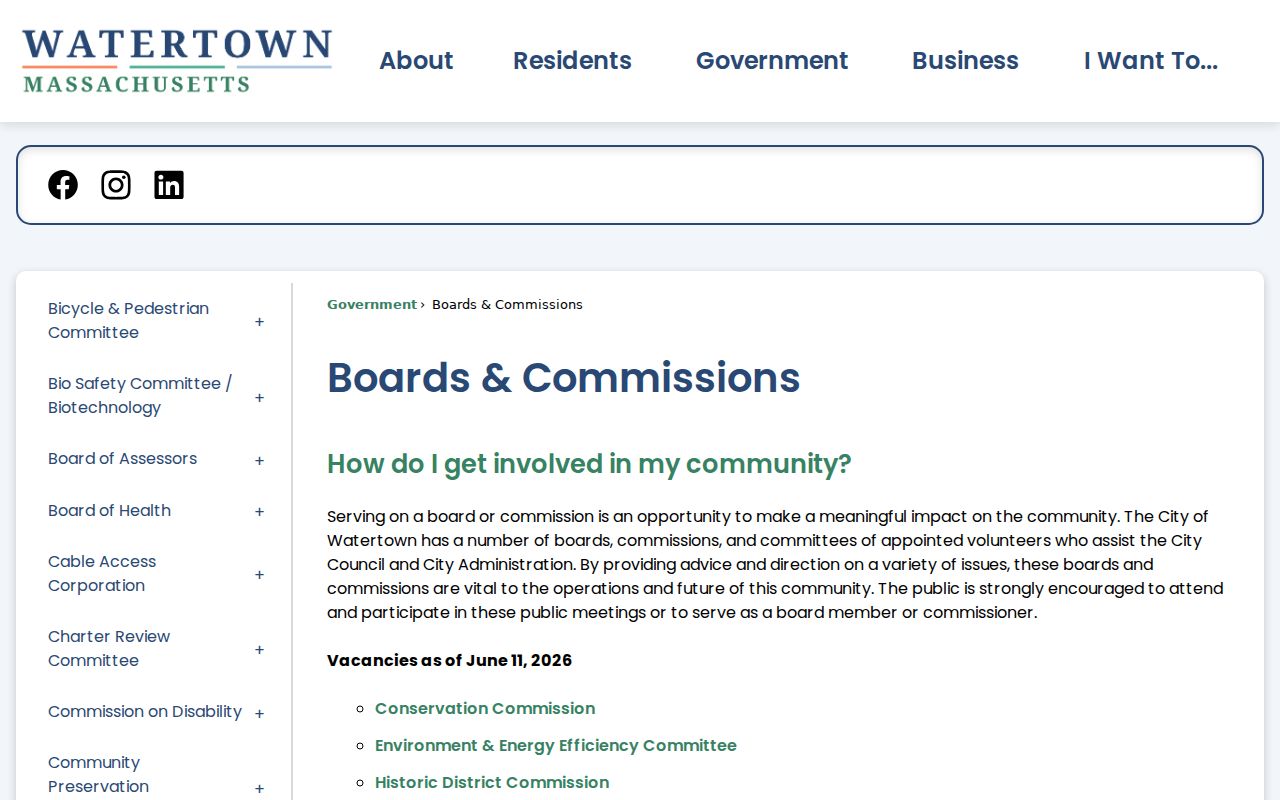
Civic records can identify public meetings and roles, while leaving private membership and household information outside the search.
For an association tied to a condominium or shared property, the more appropriate public route may be a recorded condominium document or deed reference, not a citywide roster. City Planning, the Clerk, and public meeting material can help identify a responsible office, but the research did not verify a complete neighborhood-association contact list or voluntary membership directory.
Watertown Neighbors: Source Comparison
Official records and commercial neighbor-lookup tools serve different purposes. The official trail names a custodian and exposes a defined record such as a parcel, deed, permit, or locally releasable voter field. Commercial tools may combine material from many sources, but their matches can be stale, incomplete, or attached to the wrong person. Neither category replaces a careful record-by-record comparison.
| Category | Strength | Limit to remember |
|---|---|---|
| Official parcel, deed, permit, and voter records | Named custodian and specific record type | Each source is narrow; privacy exclusions and update gaps apply |
| Commercial neighbor-lookup tools | May present broad, mixed-source leads | Accuracy, dates, and identity matches require independent confirmation |
When a commercial result points to an address, return to the relevant Watertown parcel, Registry document, or City record before relying on it. The official source may still be limited, but it gives the reader a clearer date, scope, and route for correction or a records request.
Watertown Neighbor Privacy Limits
Many block facts remain private. Public sources generally do not provide a complete list of renters or household members. Utility accounts, delivery data, and DMV address records are not general resident sources. Confidential voters, minors, protected court matters, and participants in the Massachusetts Address Confidentiality Program have additional protections. The ACP shields an eligible participant's actual address from public inspection except for limited legal channels.
The City Clerk and Records Access Officers are the documented fallback for a specific city-held record. Under the Massachusetts Public Records Law, M.G.L. c. 66, §10, a requester may ask for a public record, but exemptions and protection rules still control what may be released.
Public records can also be incomplete for ordinary reasons. A permit may be at a different approval stage, an assessment snapshot may be dated, a directory may skip a year, and a property owner may be different from a resident. Treat each result as a dated record with a defined purpose, then confirm material questions with the office that holds it.
Lawful use. Use Watertown neighbor information for personal, civic, or property curiosity. Do not combine records to monitor, threaten, intimidate, or harass another person.